Air Travel: Experiences and Metaphors
It’s been a turbulent few days for public markets and for relations between Anthropic and the US Department of War. Flying through that turbulence, I had two very different airport accessibility experiences.
It turns out all airports are not unmitigated hell for blind travellers. Coming home from Silicon Valley, my Uber to San Francisco airport was met by not one, not two, but three members of staff. I was whisked through the airport by a seamless relay of assistants, never left anywhere to wait and never forced to sit in a wheelchair.
With apologies for a rather forced segway, air travel does also provide some useful metaphors for the perennial questions of AI progress and its impact on employment.
The eminent economist and author, Erik Brynjolfsson believes that AI caused a productivity boom last year and associated increases in unemployment (the same output produced by fewer workers).
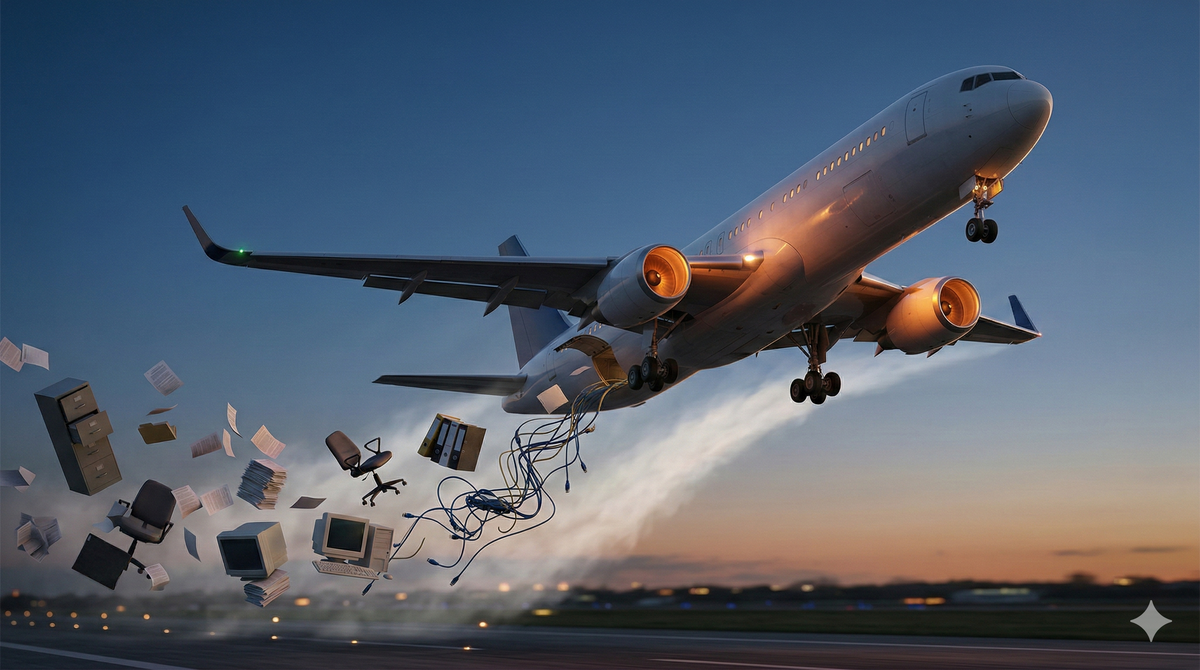
Although some economists of course disagree with his conclusions, Brynjolfsson thinks these are signs we have reached a J curve inflection point. This opaque language is much loved by economists and techies alike, but more simply put, the plane is about to take off. We have been trundling down the runway, not much changing, gradually picking up speed, but at some point everything will change and we will start climbing very, very quickly, with the engines screaming and anyone not strapped in will get a nasty surprise.
Front running this accelerating change, shares in the payment terminal provider Block soared last week when their CEO, Twitter founder Jack Dorsey, announced an immediate 40% reduction in their 10,000 strong workforce, anticipating increased operational efficiency with a much smaller, AI assisted workforce.
Conversely, a recent scenario postulation by the little known Citrini Research wreaked havoc on the markets. For example IBM shares plunged 15% simply because the essay cited IBM amongst likely losers in AI fuelled disruption of many traditional technology players.
This public market turbulence fuelled by opinions not facts is very unhelpful. Nonetheless, after an intense weekend at the Friends of O’Reilly Social science FOO Camp in Mountain View, I do think the impacts of AI on the economy and on employment will accelerate much more quickly over the next 12-24 months, bringing changes for which politicians and policy makers are not yet prepared.
As if market volatility/job uncertainty was not enough, and Somewhat overshadowed by the war with Iran, things truly came to a head last Friday between the US government and Anthropic, one of the three leading Large Language Model providers.
Their CEO Dario Amodei’s carefully worded statement declined to remove restrictions in their contract with the Department of War , Those restrictions prevent use of their technology for mass surveillance of US citizens or for fully autonomous lethal weapons with no human oversight.
Anthropic have been consistently more open than their rivals about the safety risks of Large language Models and these restrictions were always in their contract with the Department of War.
Here’s the full text of President Trump’s response on his personal social media platform:
“THE UNITED STATES OF AMERICA WILL NEVER ALLOW A RADICAL LEFT, WOKE COMPANY TO DICTATE HOW OUR GREAT MILITARY FIGHTS AND WINS WARS! That decision belongs to YOUR COMMANDER-IN-CHIEF, and the tremendous leaders I appoint to run our Military.
The Leftwing nut jobs at Anthropic have made a DISASTROUS MISTAKE trying to STRONG-ARM the Department of War, and force them to obey their Terms of Service instead of our Constitution. Their selfishness is putting AMERICAN LIVES at risk, our Troops in danger, and our National Security in JEOPARDY.
Therefore, I am directing EVERY Federal Agency in the United States Government to IMMEDIATELY CEASE all use of Anthropic’s technology. We don’t need it, we don’t want it, and will not do business with them again! There will be a Six Month phase out period for Agencies like the Department of War who are using Anthropic’s products, at various levels. Anthropic better get their act together, and be helpful during this phase out period, or I will use the Full Power of the Presidency to make them comply, with major civil and criminal consequences to follow.
WE will decide the fate of our Country — NOT some out-of-control, Radical Left AI company run by people who have no idea what the real World is all about. Thank you for your attention to this matter. MAKE AMERICA GREAT AGAIN!”
Secretary of War Pete Hegseth swiftly followed the president’s lead with strong words of his own, designating Anthropic as a supply chain risk.
This designation, intended for companies affiliated to hostile foreign powers, not only prevents Anthropic from supplying their technology to the US military, but also theoretically prevents them from supplying it to any other company that works for the US military. Although this appears to be a significant restriction on Anthropic, prediction markets are pricing in almost no effect on their prospects. This may be because the government action is illegal, but also because public sentiment has swung strongly from OpenAI to Anthropic's principled stance, with their chat agent, Claude, jumping to top spot on the iOS App Store.
Although Sam Altman initially supported Amodei’s stance, within hours he then announced a replacement supply agreement between his own company, Open AI, and the Department of War. This agreement was presumably well under way before Anthropic were expelled. Unrelated, but worth noting, Open AI chairman, Greg Brockman previously donated $25M to Trump’s campaign fund.
The US government can clearly choose whichever suppliers they judge best for national defence. But Large Language Models are powerful, unpredictable and not even properly understood by their own makers. I struggle to square unconstrained access to this technology with such prima facie intemperate and disproportionate language from Trump and Hegseth.
Finally returning to the banality of airport accessibility hell, upon landing at Heathrow, the obligatory buggy sported a dystopian white noise generator straight from THX 1138. The driver was fully occupied cross-checking lists with colleagues and I was twice abandoned for many minutes on end while more passengers were corralled, loaded on to one buggy, and then unloaded inexplicably to wait for another. Eventually, within spitting distance of the exit into the free world I was told to wait for yet another buggy (presumably because the current driver now needed a rest break). At this point, after an 11 hour flight, I confess to losing the rag as well as the will to live. But at least that had the desired effect, getting me grudgingly but swiftly escorted on foot through the exit before a messy incident that we would all come to regret.
San Francisco felt like well choreographed personal accessibility with human dignity while Heathrow felt like anonymous, chaotic, legally compliant accessibility at minimum cost.
If you know how to navigate unprecedented disruption to the global economy, how to calmly negotiate US government contracts or how to fix Heathrow’s accessibility hell then please do comment.