Airports: A Special Circle in Dante's Inferno of Accessibility Hell
Airports are stressful for everyone, but for blind travellers they can become a labyrinth of broken processes, awkward rules, and misplaced “assistance.” A personal account of how accessibility often fails in physical spaces—and why better design still matters.
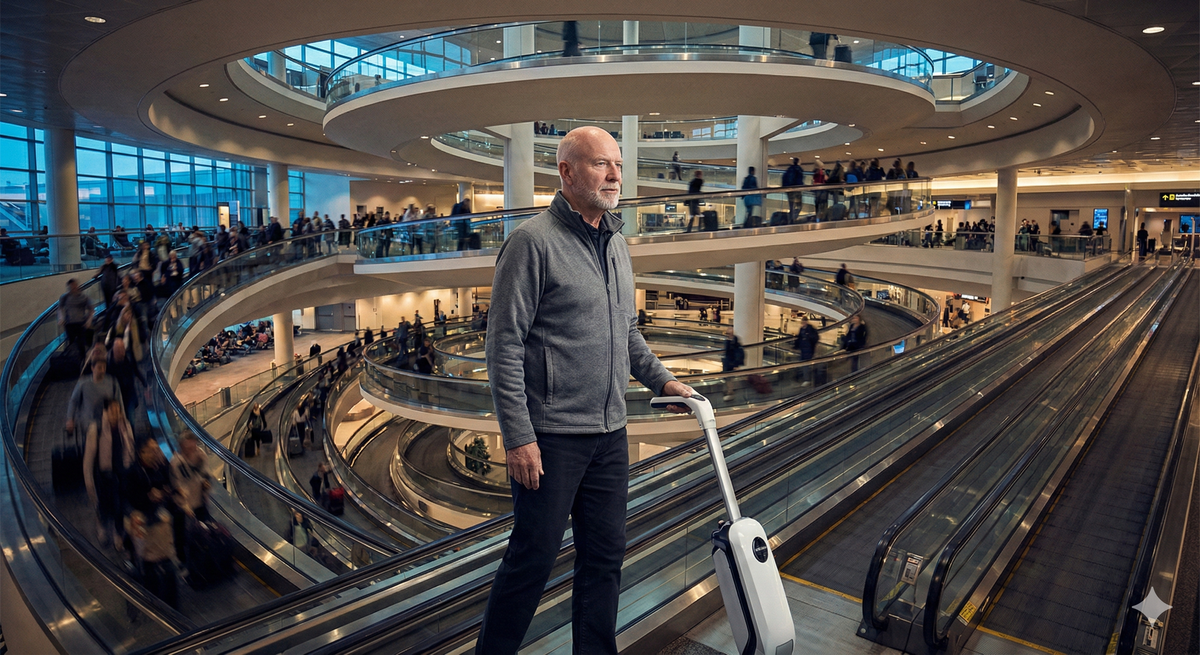
For most of us airports are a fairly unpleasant experience. I only know one guy who is addicted to these abominations, and sadly this is such a niche addiction that there are literally zero self-help communities available where the afflicted can stand up in front of their fellows and publicly declare their uncurable love of endless travelators, incessant announcements, bad food and interminable queuing.
But if you’re blind, and travelling alone, the general unpleasantness of the experience reaches a whole new level of unmitigated misery.
In an airport like Heathrow, which employs over 75,000 people, with 40-60 miles of corridors according to ChatGPT, the navigation challenge for blind travellers is inevitably large. I am almost sure that airport designers do employ accessibility consultants, but I genuinely wonder who reviews their plans and decides that they are good enough.
This rant is fresh in my mind as I’m writing somewhere over Trump’s aspirational 51st state en route to San Francisco. Not all of the examples here happened to me today, not least because I met up with a friend inside the terminal. But I’ve experienced all of these myself and many of them multiple times.
- Particularly at Heathrow, taxi drivers are in constant fear of being towed if they step more than a couple of metres from their vehicle. They are literally unwilling to walk me the 10m to the Help Point which is now the prescribed way for disabled travellers to get assistance.
- You might imagine such assistance would include actually getting into the terminal given that taxi drivers cannot leave their vehicles, but apparently not. I’d like to blame the crass response to my request for help finding the entrance to the terminal on an AI but sadly it was a human who suggested with no obvious irony: ”If you just go to desk 32 inside the terminal someone there can provide you with that assistance.”
- At desk 32 I’m usually castigated for not turning up 3 hours before a 2 hour flight to give the numpties running the service enough time to recall an assistant from the other end of the terminal. Remind me again why I have to pre-book assistance because it clearly has sod all to do with resource planning.
- Although I’m manifestly more mobile than some of the assistance staff, I’m sometimes required to sit in a wheelchair because it will be quicker, safer or simply what the rulebook requires. And sometimes I even have to wear a seatbelt. I have not yet established if this is a precaution against impact from another blind man marauding unescorted through the airport or if I’m likely to be thrown out the chair by the extraordinary G forces as we race through the security line chicane. Matt Weston eat your heart out.
- Increasingly I’m taken outside the terminal into a hydraulic hoist designed by failed engineering students rather than just being walked down the jetway with all the other passengers in command of their own legs.
- After 90minutes waiting at desk 32, a necessary detour via the Inclusive Facilities can often inject a little additional frustration not specific to airports. photo sensitive flushes, taps and soap dispensers are the controls du jour in these toilets, which is presumably helpful for some users with limited motor skills. But there is not to my knowledge any standard for how these things are laid out. And call me squeamish if you like, but I’d honestly rather not feel my way around every nook and cranny hoping to trigger the flush, only to squirt soap over my sweater, or put my hand into a bin of used tissues.
This post has little to do with AI today, but it does have a lot to do with accessibility challenges in the physical world. I am so looking forward to the day when my Glide robot guide dog from Glidance can get me all the way unassisted from my taxi to my gate. With it’s substantial battery pack I’m sure the Glide will cause some teeth sucking at the security line, but that’s a conversation for another day.