Ariadne's Thread
An exciting vibrating necklace is on the way, providing ultra-precise navigation assistance
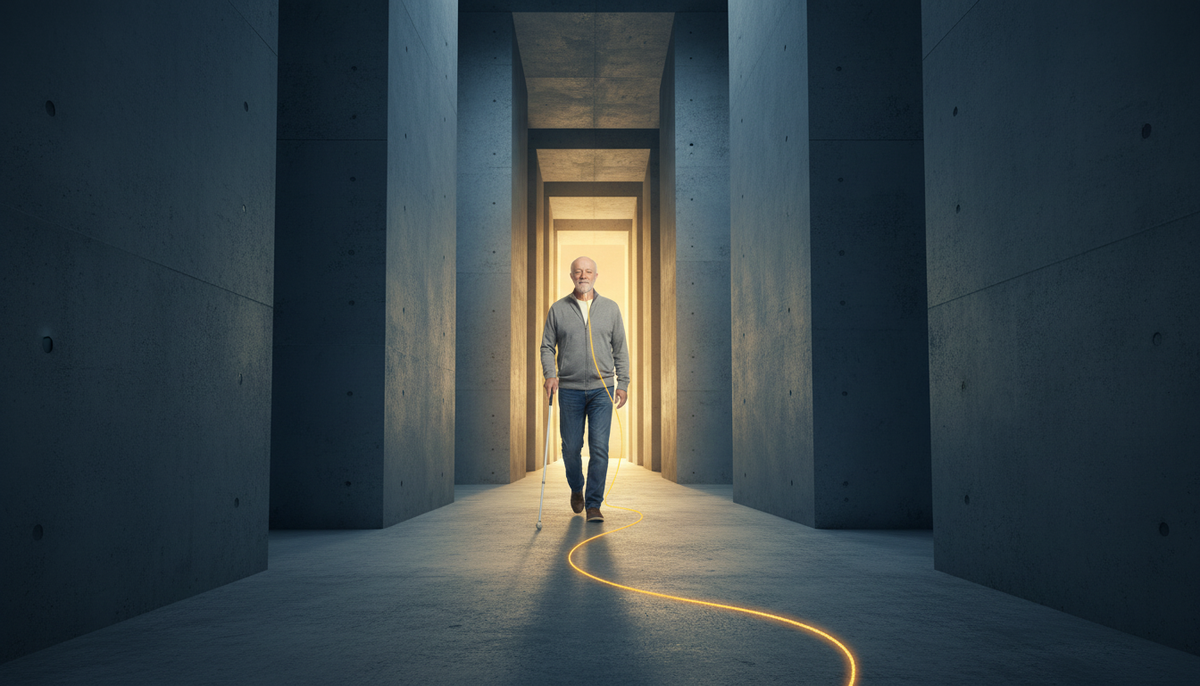
Last Wednesday I spent 20 minutes lost in the labyrinthine basement of my hotel. In Greek mythology the labyrinth is the disorienting lair of the man-eating Minotaur. Sacrificial virgins consigned there die in darkness, despair and terror. I had already progressed from darkness to despair when I was miraculously rescued by a wondrous angel disguised as a hotel cleaner.
Entirely coincidentally, 4 hours later I was shown a prototype haptic necklace that, even absent the angelic intervention, really would have saved the day (or at least saved the first 20 minutes of the day). Bear with me while I go through some background and we'll come back to the necklace later.
The famous 'Get Out Of The Labyrinth Free' card in the myth is Ariadne's ball of thread. The protagonist, Theseus, simply unwinds the thread on his way in, slays the monster with his bare hands, and then re-traces the thread to sail away with the heroine Ariadne. OK, things go downhill from there, but that's a different story.
This trick with a thread is about as ancient and primitive as the white cane. But interestingly, although we still haven't created an effective digital white cane, we can now create a digital, infinitely long ball of thread. Anyone who has planned a custom cycling route using applications like Komoot or RideWithGPS has added waypoints to a map. This sequence of waypoints is the thread along which your Garmin satnav guides you, comparing your GPS location in the physical world to the thread's location in the digital one. More dynamically, the Garmin, or even an Apple Watch can create an ad hoc digital thread you can subsequently retrace – exactly the Get Out Of The Labyrinth Free feature from the myth brought into the modern world.
Blind navigation aids must similarly follow planned or ad hoc routes, but with 4 additional complexities:
- Precision: 5 metre accuracy is good enough for finding a road turning on a bike, but is absolutely not good enough for finding a kerb or a shop door.
- Communication: Showing the digital thread on a visual display is a great UI for cyclists but truly useless for blind pedestrians. And although voice instructions are great for augmenting a map, just try following them with your eyes shut – it's hopeless.
- Ubiquity: Cycling indoors is not a strong requirement but blind navigation indoors certainly is.
- Obstacle Avoidance: Cyclists can use their eyes to avoid obstacles such as potholes and other road users. Blind pedestrians definitely cannot.
Put like this, it's easy to see why blind navigation technology is such a fiendishly intractable problem. A white cane used well can address Precision, Ubiquity, Obstacle Avoidance and some elements of Communication. Specifically on Communication, the cane gives me tactile feedback. If there's a wall in front of me my cane will hopefully hit it before my head. Interestingly, once I have explored a route, often with a companion, static and permanent obstacles become an invaluable element of route following; walk forward until I hit the wall, walk left along the wall until the second drainpipe, turn sharp right to the kerb, cross the road to the railings and follow these until I hit the steps. Counter-intuitively, the very absence of obstacles makes route following with nothing but a white cane extremely hard. I know that I need to cross the carpark diagonally to reach the exit. But on a flat expanse of tarmac how do I know if I'm just far enough off track to miss the exit and instead entangle myself in the bike racks or fall down the steps? Hold this thought – not the image of me doing battle with a bike rack, but the challenge of following a route in an undifferentiated space.
Guide dogs are even more useless than me at ad hoc route discovery. Having said that, they are much better than me at navigation by visual or olfactory markers through an obstacle-free, undifferentiated space once they've walked it several times. But at a cost relative to a white cane - you really can't fold a 35Kg retriever up and slip it in your backpack.
Glidance will start rolling out their guide dog alternative later this year with bold plans to address the full gamut of requirements, maybe even making the guide dog and the white cane both obsolete. But the Glidance device is also quite chunky and will I'm sure take several years to fully mature.
So finally back to the haptic necklace from Robert Quinn and his brilliant team at MakeSense, who are taking quite a different approach to Glidance. The MakeSense necklace I tried last Wednesday is for use in conjunction with a white cane, not instead of a white cane. Their mission is to be the world's best device for high precision route following, communicating turns and slight adjustments to the wearer with 360 degree haptic feedback. A little spot on the necklace vibrates in the direction you need to turn and as your body comes into alignment with the route, the spot moves towards your sternum, and stops vibrating once you are perfectly on track. It really is very impressive and surprisingly intuitive to navigate, staying within 5 degrees of the digital thread. If the thread leads across an open expanse, when the exit is still 100 feet away I will already be on track to bisect the bike racks and the steps. And at 50 feet I would even be on track to find a specific shop doorway, not the shop window or the adjacent shop doorway. Alright, the necklace is absolutely not a catwalk worthy thing of beauty. but who needs gold and diamonds when at least I can now promenade down the catwalk without spontaneously faceplanting into the audience.
And there are of course plenty of challenges getting a reliable GPS fix in subterranean labyrinths, or even on the open streets of London, surrounded by tall buildings. But there are lots of things that can be done with sensor fusion from cameras, ultra wide band time of flight radio waves and myriad other techniques used by indoor and outdoor autonomous vehicles. Bring on the autonomous blind man. A virtual thread, laid down with the necklace on my first guided trip from elevator to basement gym, would make navigating back to the elevator a piece of cake. Far more significantly, each route walked once with a companion will have its own unique thread stored for me to follow. Pre-canned high precision routes can be readily curated or crowd sourced in airports, town centres and innumerable other locations. With the most detailed maps available from Ordnance Survey, it will be possible to create routes on the fly, just as we all take for granted in our cars, but now with enough precision to get me the final elusive few metres after my Waymo blithely but wrongly announces that I have reached my destination.
In the meantime, MakeSense have just won a £700k government innovation grant. They are seeking match funding from early stage investors and I'd be delighted to connect anyone who can possibly help.