What is it like to be a bat, or a bot?
More musings on the tricky question of subjective experience and the impossibility of distinguishing mimickry from true consciousness.
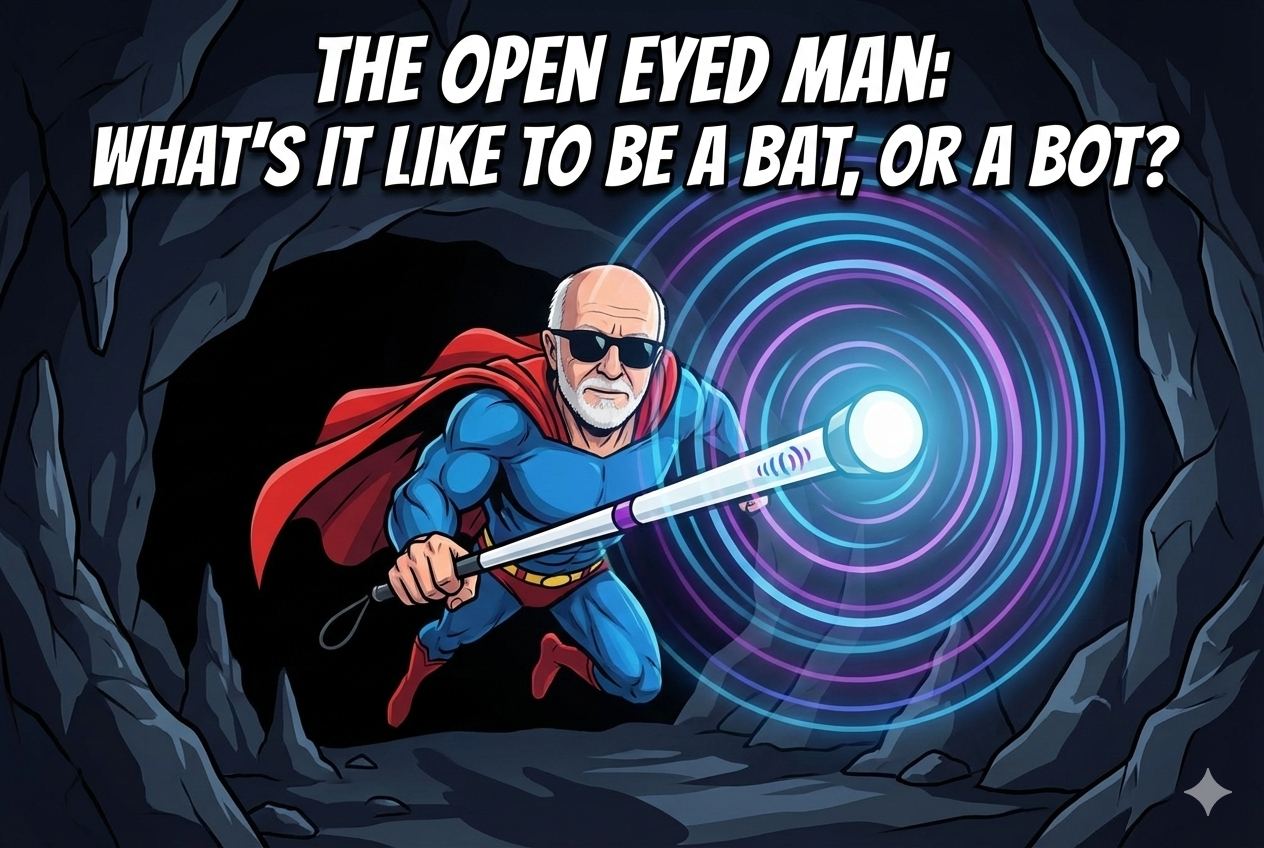
Bat, as in ‘blind as a bat’, is the short hand used by my blind friends and our close circle (no offence intended or taken), to refer to blind people, their accoutrements and their behaviours. I am a bat, my mobility cane is a bat stick, accessible environments are bat friendly, and cringe-worthy social faux pas like mistakenly taking the hand of the wrong woman are batty moments.
No-one can know how I feel to be a bat. You can try to imagine it and you can even walk around for a whole day in a blindfold, tripping over steps, spilling your wine or scaring yourself shitless trying to cross a busy road. So you can, at some cost, find out how some blind experiences feel to you, in the moment, but that’s not the same as knowing how I feel to be blind.
The 10,000 hours rule absolutely applies in spades to bat proficiency. So it’s reasonable to assume that I might feel the bat experience less acutely than you. Conversely, the bat experience over time is much more complex than the individual batty moments, with a lifetime of social exclusion, frustration, dependence, and for 75% of bats includes long-term unemployment. So maybe the blind experience as a whole is much more challenging than the sum of its individual parts. But the reality is that being a bat is a subjective experience. Only I can know how I feel – all you can do is observe how I behave and listen to how I say I feel. And how I feel may be entirely different to how other blind people with identical experiences feel.
I’m borrowing heavily from Thomas Nagel’s influential 1974 philosophical essay on consciousness, titled ‘What is it like to be a bat?’. Nagel was of course referring to the lived experience of flying mammals with echo-location super-powers , not vision impaired humans. His point was that humans [blind or otherwise] cannot know what it actually feels like to be of the order Chiroptera. We can only observe how bats behave. Many philosophical schools of thought who differ on the nature of consciousness do nonetheless agree that we can only observe the behaviours of another being and then infer whether the being is, on balance, probably conscious.
We have collectively decided that chiroptera are conscious, partly because they are mammals, but also because they appear to experience pain and other emotional triggers and have long term memory.
Last week’s post discussed AI consciousness, where mostly at the moment we would say the question ‘What is it like to be a bot?’ makes no sense. It is not ‘like’ anything to be a bot – a bot is just a set of algorithms processing bits and bytes of data. But the challenge is that AI can increasingly exhibit behaviours that look like small parts of consciousness. Equipped with enough sensors, embodied as a robot and with more evolved algorithms it seems plausible that AI could exhibit the external behaviours that are indistinguishable from other beings which we have already deemed to be conscious. At that point, with demonstrable episodic memory and what look like valenced experiences (events that positively or negatively affect our emotional state), it’s hard to argue that AI is not conscious unless we use some other criteria.
Obvious such criteria include natural evolution or carbon based internal thought machinery. Either of these criteria work well today but with rapid progress in synthetic biology and in biologic computing both criteria could become less bright lines in the next decade. This matters if we believe that retaining control over AI becomes much harder if we accept it is conscious and therefore has moral rights. If we cannot robustly use the evolutionary/biological criteria how do we define an intelligence as ‘artificial’ and hence, possibly by fiat, as not conscious?
Now is the time to move this question from abstract academia into mainstream public discourse. I’d love to hear your thoughts so please do comment using the link below.