You have arrived at your destination
For blind users of public transport, the fun and games really starts when a sighted traveller, an Uber driver or a sat nav would reasonably claim you have reached your destination. Here are a few recent anecdotes.
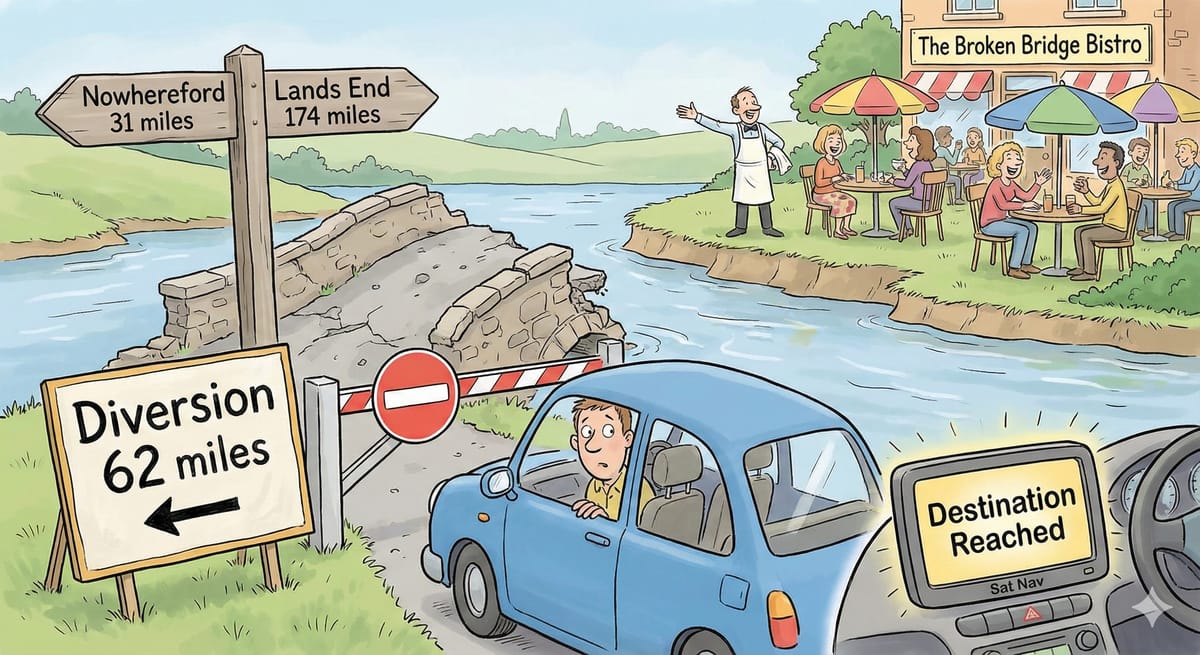
The all too familiar smug announcement of alleged arrival at our destination is sometimes for me the start of a whole new journey of bumbling exploration, frustration and bafflement, occasionally concluded with a laugh out loud realisation of what’s going on.
Here are 3 of my recent experiences using public transport that highlight a few of the challenges.
1. Spoiling The Ship For A Ha’p’orth Of Tar
Especially for non-native British English speakers this heading merits a quick explanation. Ha’p’orth is a contraction of half penny worth, and the expression means spoiling a larger enterprise by scrimping on a small detail. The London underground has an excellent service escorting Vision Impaired Passengers (VIPs) from the gate to the train, between trains at an interchange and to the exit gate when I reach my destination. The challenge is that my destination is never the exit from the underground, it is either a venue very close to the exit or a taxi for onward transportation. It should be blindingly obvious to Transport For London that anyone who cannot get from the gate along a smoothly surfaced and regular corridor to the platform and on to the train may just possibly find it challenging to get 30 metres along a cluttered pavement to their actual destination. Nonetheless the escorts are not allowed to set foot outside the station, sometimes apologising but quite often having no useful suggestions regarding WTF I should do next. . This policy when rigorously applied destroys a brilliant service, turning it into an unhelpful minimum discharge of a legal duty to provide equal access. To be fair, over many years I’ve learned which stations have pragmatic supervisors who balance the need for adequate station staffing with a genuine desire to actually help.
2. The Mystery Of tactile markings
One particular rule conscious London Underground customer assistant abandoned me at the exit and advised ‘When you get halfway to the next sideroad there are pedestrian lights to cross the main road’. Not knowing when I’m halfway to a destination which I cannot see would not be a problem if I could just find the rumble strip marking the crossing point. These tactile markings close to the kerb, which have proliferated over the last 30 years, have always mystified me. They are perhaps mildly reassuring under your feet when you’ve already whacked the light stanchion with your white cane, but how are you supposed to find them when you’re in the middle of a wide pavement? Walking along the kerb looking for a modest tactile square feels unnecessarily fraught and dangerous, involving encounters with lampposts, parked cars, fire hydrants and other miscellaneous street furniture. Wouldn’t the obvious solution be to have a rumble strip crossing the entire pavement designating the crossing point? I look forward to enlightenment about the current approach by any town planner reading this, or failing that, does anyone know Colin, GCHQ’s Chief Puzzler?
And while I’m ranting about rumble strips, train stations frequently have a very welcome safety strip at the edge of the platform to warn blind travellers when they are approaching the danger zone. Our local station has a frequent audio announcement warning travellers that the rumble strip on this particular platform is only partial.
Crossing a smooth piece of platform, how am I supposed to know whether I am safe because I have not yet reached the warning strip or in mortal danger because this particular platform section is bereft of strip? Personally I’d sooner dispense with the partial strip completely, save a few pence on my ticket and not have to suffer the irritating safety announcement every 5 minutes about the unsafe safety strip.
3. Getting lost in translation
On a problematic no stopping red route an Uber driver very kindly explained he would park at the Texaco and walk me across the road to my lunch venue, which worked a treat. The following week my friend agreed for simplicity to actually meet me at the filling station. I duly selected the only Texaco station in the area as my destination and asked the new driver to leave me somewhere safe and visible until my friend arrived. This he did, explaining that I was by the Co-op. Some 15 minutes later my friend eventually found me outside a Pret nowhere near the Shell filling station opposite the restaurant.
It turns out that in a particularly niche Uber driver dialect, Texaco is a generic word for a filling station and Co-op is a generic word for a small retail establishment. That little linguistic conundrum nicely passed the time as we walked the 800m back to the restaurant.
I have many, many more navigational mishap anecdotes, but the good news is that some combination of waving my cane, smiling, asking nicely, stumbling around, tripping and swearing profusely usually summons a helpful fellow traveller, And if not, I can always ask a Be My Eyes volunteer (quite possibly speaking from Chicago, Delhi or Singapore) to guide me down a busy pavement in Central London.
Despite all these workarounds, I am very much looking forward to the day when my smart glasses and AI agent or my Glide can ensure I do actually reach my destination as a genuinely independent traveller.
Finally, an apology and an ask regarding The Blind Mans Arms website which I built last week.
Apology to low vision readers. A comment from my youngest brother on last week's blog post highlights the complexity of accessibility. Although my brother is registered blind (not partially sighted), he still has enough residual sight to work with visual user interfaces using screen magnification software and high contrast colour palettes. Statistics on residual sight amongst the registered blind community are not rigorous but the consensus figure,
e.g. reported by the RNIB in the UK, is that 95% of the registered blind community still have some residual sight. I am the only one of my 5 siblings with zero sight even though we are all registered blind. Despite knowing this strong skew towards some residual sight I completely failed to specify high contrast colour palettes or other measures on The Blind Mans Arms website that would help low vision users with residual sight. Sorry. Rather depressingly, Claude Code, which built the website under my instruction also did not choose appropriate colours or offer a high contrast theme.
Ask to everyone. If you didn’t visit The Blind Mans Arms website already, please do check it out and start a conversation with Christopher The Blind via the Start A Call button at the bottom of the home page. Don’t worry, you won’t be asked for credit card details, you don’t need to give an actual email address and I’m not building a database of victims for future phishing attacks. But I am very interested in whether conversational voice is a viable interface paradigm both for information gathering (e.g. to browse the pub’s menus) or for form completion to make a reservation or to make a purchase. I’d love to hear your feedback, particularly if you are vision impaired.